Updated October 18, 2026: Blade precautions moved before handling, wet-grass blade advice removed, and U.S. aftermarket-battery warranty wording corrected in the guide and FAQ.
Disclosure: As an Amazon Associate, I earn from qualifying purchases.
Our guides are research-based. We compare official specifications, manuals, warranty terms, owner feedback patterns, and competing products. Unless we specifically say otherwise, the product has not been personally tested by our editorial team.
Buying a replacement blade or battery for a cordless mower is where most people waste money. The part looks right in the photo, the brand name matches, and it still doesn’t fit — or it fits and voids nothing but delivers half the runtime you expected.
This guide covers the three parts you’ll actually replace: blades, batteries, and chargers. The goal is to get you ordering the right one the first time.
Quick answers
- Blades: Never match by mower brand. Match by OEM part number and four measurements: length, width, thickness, and center hole.
- Batteries: Voltage is the hard boundary. A 40V pack will not run a 60V tool, even from the same brand. Amp-hours (Ah) change runtime, not power.
- Chargers: A faster charger doesn’t give you more runtime. It shortens the gap between batteries — useful only if you’re actually waiting on a charge.
Part 1: Mower blades
Why “fits Greenworks” is not a fitment claim
A blade doesn’t fit a brand. It fits a specific spindle and deck. Two mowers from the same manufacturer with the same deck width can take completely different blades.
Aftermarket makers publish fitment by OEM part number for exactly this reason. A single 8TEN LawnRAZOR listing, for example, specifies blade length, center hole size, thickness and width, along with the list of OEM part numbers it directly replaces — and 8TEN sells dozens of different LawnRAZOR SKUs across that line, each with its own fitment list. Asking whether “8TEN blades” fit your mower is like asking whether “Bosch parts” fit your car.
The four measurements that decide fit
| Measurement | Why it matters |
|---|---|
| Length | Determined by your deck. A blade even slightly too long will strike the housing. |
| Width | Affects lift and clearance inside the deck. |
| Thickness | Thinner blades flex and dull faster; too thick may not seat correctly. |
| Center hole | The most common mistake. Holes come round, bow-tie, 5-point star, 6-point star, and 7-point star, in several diameters. A round hole will not sit on a star spindle. |
Some blades also have outer mounting holes that must line up. If the center hole is a star pattern, that pattern has to match exactly — not approximately.
How to find your number (5 minutes)
Before touching, wiping, measuring or removing a blade: Stop the mower and wait for the blade to come to a complete stop. Follow the model’s manual to isolate power: remove all removable battery packs and the safety key if fitted, or unplug a corded mower from the power supply. For models with a built-in battery, follow the manual’s isolation procedure before proceeding.
Wear heavy protective gloves. Position and support the mower only as its manual directs, keeping it stable and your hands clear of sharp edges. A stopped blade is still sharp. If you cannot safely isolate or support the mower, have a service technician inspect it. EGO’s LM2100/LM2100SP manual provides a model-specific example.
- Look on the blade itself. Most OEM blades have the part number stamped into the steel. Wipe the grass off and check both faces.
- Check the manual. The parts diagram lists the blade part number.
- Use the mower’s model and serial plate. Usually under the deck or on the rear housing. Model number alone is sometimes not enough — serial ranges can change mid-production.
- Search that OEM number, not your mower’s name. Aftermarket listings cross-reference OEM numbers directly.
- Measure the old blade before ordering if you’re replacing an aftermarket blade someone else installed. You can’t trust that it was correct.
If you only do one thing: measure the center hole and count the star points before you order.
Blade types: which one you want
Blade profile changes how your mower behaves more than most people expect.
- Low-lift — Less suction and less airflow. Best in dry, sandy, or thin conditions where a high-lift blade would pull up dust and debris. Quieter, and easier on the motor.
- Medium-lift / standard — What most mowers ship with. A middle ground that handles typical conditions.
- High-lift — Designed to increase airflow for bagging. Choose only a high-lift blade approved for your exact mower; it can reduce battery runtime. Mow dry grass and follow the mower’s manual. A high-lift blade does not make wet-grass mowing advisable.
- Mulching — Curved cutting surface that keeps clippings circulating in the deck to be cut repeatedly, then drops them evenly into the lawn.
The battery-specific caveat: on a cordless mower, high-lift and mulching blades pull noticeably more current than standard blades. If you’re already finishing your lawn with little charge to spare, an aggressive blade upgrade can push you into needing a second battery. That trade-off doesn’t exist on gas mowers, and it’s the single most overlooked point when people upgrade blades on a battery machine.
Mulching blades vs. mulching kits
A mulching blade alone is not a mulching system. Most mowers also need the discharge chute blocked by a mulching plug or insert. A mulching blade with the side discharge open will just throw partially-cut clippings.
If your mower is advertised as 3-in-1 or 4-in-1, it already includes the plug. If it’s a basic side-discharge model, check whether a plug is even available before buying the blade.
When to replace rather than sharpen
Sharpen a blade if it’s dull but straight and unworn. Replace it if:
- The trailing edge is worn thin or the lift wing is eroded
- There are dents or nicks deeper than roughly 1/2 inch
- The blade is bent, or the center hole has become egg-shaped
- You’ve sharpened it enough times that the cutting edge has visibly receded
A bent blade is worth taking seriously. It puts the spindle out of balance, and on a cordless mower that vibration goes straight into the motor bearings.
Part 2: Batteries
Voltage is a wall, not a suggestion
Within a brand, batteries are only interchangeable inside the same voltage family. This is where most money gets wasted.
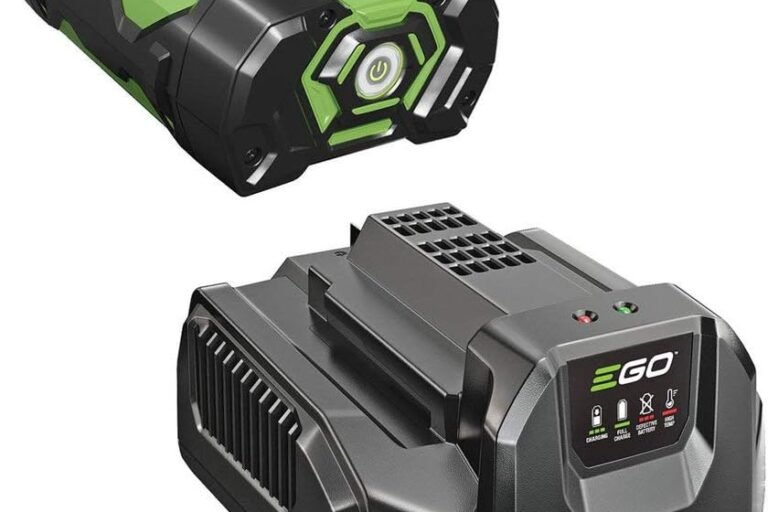
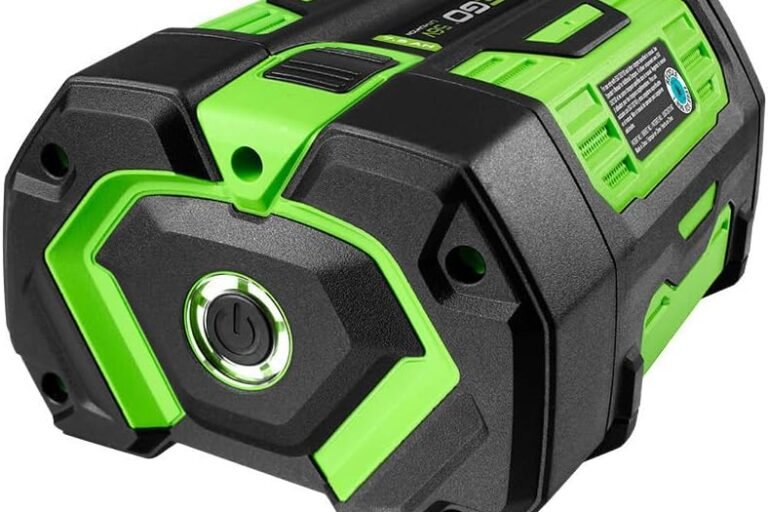
EGO runs a single consumer platform, which makes it the simplest: EGO states that all EGO ARC Lithium batteries are compatible with all their tools and chargers. Any 56V EGO pack runs any 56V EGO tool. The only question is which Ah you want.
Greenworks works the opposite way. It sells 24V, 40V, 60V, and 80V families, and they do not interchange. A Greenworks 40V pack will not run a Greenworks 60V mower. The brand name on the battery tells you nothing — check the voltage printed on the pack against the voltage printed on the tool.
This catches people constantly, because both packs say “Greenworks,” both are black and green, and both physically approach the same slot.
Before buying any battery, confirm three things:
- The voltage printed on the tool
- The voltage printed on the battery
- That the seller lists your exact tool model in its compatibility list
What amp-hours actually do
Amp-hours measure capacity, not power.
- A 5.0Ah battery does not make your mower cut stronger than a 2.5Ah battery.
- It makes it run roughly twice as long.
- It’s also heavier and takes longer to charge.
Voltage relates to power. Amp-hours relate to runtime. Doubling Ah roughly doubles runtime — everything else being equal.
Why advertised runtime rarely matches yours
Manufacturers quote runtime under favorable conditions: dry, maintained grass, moderate cutting height, standard blade, steady pace. Real runtime drops with:
- Tall or wet grass — the biggest single factor
- Low cutting height — more material per pass
- Dull or aggressive blades — a dull blade tears rather than cuts, drawing more current
- Turbo or high-power modes
- Slopes
- Cold weather — lithium cells deliver less in the cold
- Battery age
Treat “up to 45 minutes” and “up to 1/2 acre” as ceilings under ideal conditions, not expectations.
How long batteries last, and how to slow the decline
Lithium-ion packs degrade on two clocks at once: cycles (how many times you charge) and calendar age (they lose capacity sitting on a shelf). Expect gradual capacity loss over several seasons rather than a sudden failure.
What genuinely helps:
- Don’t store fully charged or fully empty. Partial charge is easiest on the cells for long storage.
- Store indoors. Heat is the main enemy. A closed shed in July is the worst place for a battery.
- Let it cool before charging after a hard mow.
- Don’t leave it on the charger for months.
- Charge before winter storage, not after. Check it mid-winter if you can.
One battery or two?
Buy the second battery if:
- You regularly run out mid-lawn
- Your lawn is near the top of the advertised coverage
- You’ve added other tools on the same platform
Skip it if you comfortably finish with charge remaining. A second pack is often 30–50% of the mower’s cost — frequently more than the price gap to a higher-capacity model you could have bought outright.
On third-party replacement batteries
U.S. consumer warranty: Using a third-party battery or other replacement part generally does not, by itself, void the mower’s warranty. The FTC explains that manufacturers may exclude defects or damage caused by an unauthorized part or service. Narrow exceptions to the general rule include parts or service supplied free under the warranty, or an FTC waiver.
Warranty rights do not establish electrical compatibility or product safety. Check the exact mower, battery and charger combination against the manufacturer’s instructions; matching voltage or a pack that slides into the slot is not enough.
- Cell quality, temperature monitoring and protection circuitry can vary between packs.
- Do not assume that an advertised capacity is independently verified.
- A damaged, incompatible or poorly protected pack can overheat or cause a fire. Stop using a swollen, cracked, leaking or abnormally hot pack.
- Choose a traceable supplier with clear compatibility information, support and a return policy. If compatibility is uncertain, use the specified replacement or ask the manufacturer before buying.
Part 3: Chargers
What a fast charger changes
A rapid charger reduces the time between finishing a battery and using it again. It does not:
- Increase runtime
- Increase power
- Extend battery lifespan (fast charging generates more heat, which mildly works against longevity)
A fast charger is worth it if you’re mowing on one battery and standing around waiting. It isn’t worth it if you own two batteries, or you finish your lawn on one charge — in that case the charge happens while you’re doing something else, and the speed is irrelevant.
For most single-battery owners with a lawn slightly too big for one charge, a second battery beats a faster charger. It removes the wait entirely rather than shortening it.
Charger notes
- Charge times scale with battery size. A 5.0Ah pack takes roughly twice as long as a 2.5Ah on the same charger.
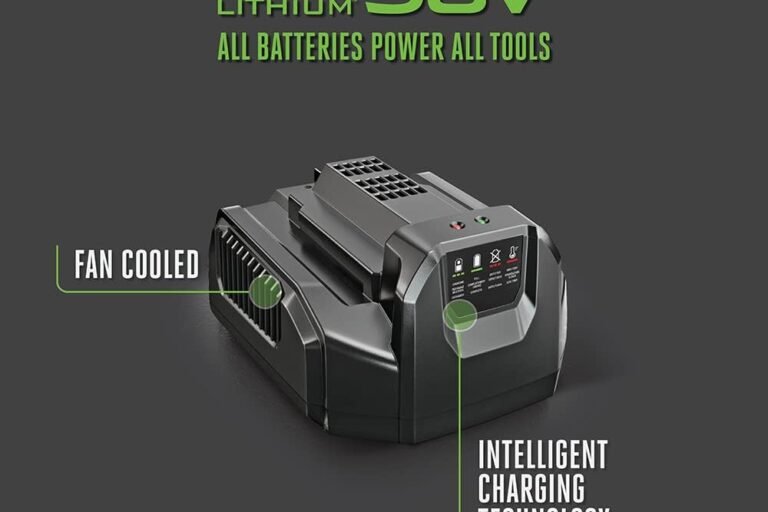
- Some chargers are fan-cooled and audible. Worth knowing if it lives in a finished garage.
- On platforms like EGO where chargers work with any battery in the range, you don’t need a matching charger per battery.
Common mistakes, ranked by cost
- Buying a battery in the wrong voltage from the right brand. The most expensive error on this list.
- Ordering a blade by mower brand instead of OEM part number. Usually returnable, but wastes a weekend.
- Ignoring the center hole shape. A 6-point star and 7-point star look nearly identical in a listing photo.
- Fitting a high-lift blade to a battery mower with marginal runtime. Now the lawn doesn’t get finished.
- Buying a fast charger to fix a runtime problem. It’s the wrong tool for that problem.
- Storing batteries in a hot shed all summer. Silent, cumulative, and irreversible.
Frequently asked questions
Are 8TEN mower blades any good?
8TEN is an established aftermarket manufacturer with a broad LawnRAZOR line covering many OEM part numbers. The more useful question is whether the specific SKU matches your mower — 8TEN publishes length, width, thickness, center hole, and the OEM numbers each blade replaces. Match on those, not on the brand name.
Will a Greenworks 40V battery work in a Greenworks 60V mower?
No. Greenworks voltage families do not interchange. Check the voltage printed on the pack against the voltage on the tool.
Do all EGO batteries fit all EGO tools?
Within the 56V platform, yes — EGO states its ARC Lithium batteries work with all its tools and chargers. Larger packs simply run longer and weigh more.
Does a higher Ah battery make my mower more powerful?
No. Amp-hours determine runtime. A higher-Ah pack runs longer, not stronger.
Can I use a mulching blade without a mulching plug?
You can install it, but you won’t get proper mulching. Without the discharge blocked, clippings leave the deck before being fully recut.
How often should I replace my mower blade?
Sharpen when dull; replace when the blade is bent, cracked, worn thin at the trailing edge, or the center hole has deformed. Frequency depends far more on what you hit than on hours mowed.
Are third-party replacement batteries safe?
Safety depends on the exact battery, mower and charger combination and the quality of the pack’s cells and protection systems. Use the manufacturer’s compatibility guidance, and avoid damaged or unverified packs. In the U.S., a third-party battery generally does not automatically void the tool warranty, but damage it causes may be excluded. Read the FTC’s warranty guidance. A return policy or warranty claim is not proof that a pack is safe.
Why is my runtime so much shorter than advertised?
Advertised figures assume ideal conditions. Wet or tall grass, low cutting heights, dull blades, turbo mode, slopes, and cold weather all cut into it — often substantially.
Related reviews
Blades
- 8TEN LawnRazor Mower Blade Review
- MaxPower 33119BDB Mulching Blade Review
- EGO AB2100D Mulching Dual Blade Set Review
- EGO AB2101D 21-Inch Mulching Blade Set Review
- Ryobi 20-Inch Replacement Blade Review
Batteries and chargers
- Greenworks 40V 4.0Ah Lithium-Ion Battery Review
- Greenworks Pro 60V Battery Review
- Toro L135 Battery Review
- EGO CH3200 Speed Charger Review
Mowers
Sources checked for this guide
- EGO Power+ official battery compatibility information (egopowerplus.com)
- 8TEN Parts published LawnRAZOR blade specifications and OEM cross-reference listings
- Manufacturer product documentation for the tools referenced above