Updated October 18, 2026: Rewritten around model-specific cooling components and safe cleaning; generic engine-filter washing advice removed.
Most battery and corded electric walk-behind mowers do not have the combustion-engine air filter found on a gas mower. They may have cooling vents, an intake screen or other model-specific airflow components. Identify your exact mower before cleaning: a grille is not automatically a washable filter.
The previous version of this article gave generic filter-soaking and replacement instructions. Those steps were not tied to a mower model and have been replaced with the manual-based guidance below.
Illustration: a decision guide for electric-mower cooling maintenance, not a diagram of a particular mower.
Before cleaning: isolate power
- Stop the mower, wait for all moving parts to stop and let hot components cool.
- Remove all removable battery packs and the safety key if fitted. For a corded mower, unplug it from the power supply. If the battery is built in, use the isolation procedure in the model’s manual.
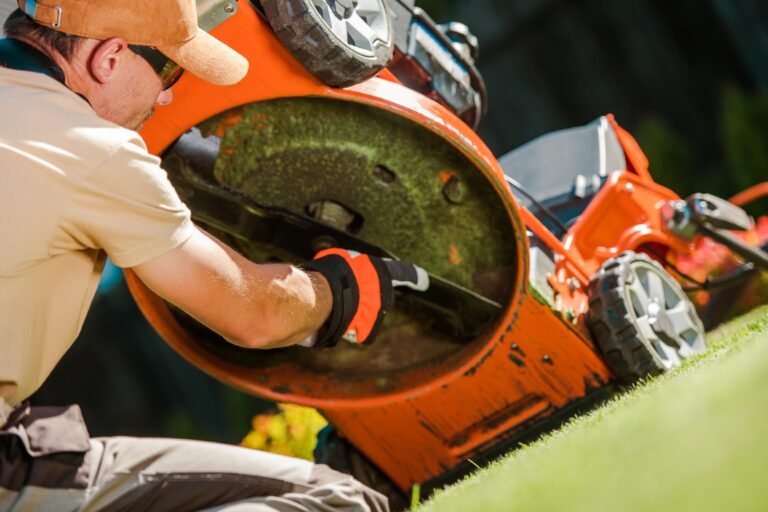
- Keep the mower stable. Follow the manual before tipping it or accessing the underside. Wear heavy gloves if working near the blade; wear eye protection where the cleaning method requires it.
If you cannot identify a safe isolation or access procedure, stop and contact the manufacturer or a service technician.
Find the cooling components your model actually has
Record the model and, where required, type or serial number from the mower’s label. In the matching manual, look for “maintenance,” “cleaning,” “air intake,” “motor fan” or “ventilation.” Check the battery and charger manuals separately; their cooling and cleaning instructions may differ.
Do not remove a cover, open a battery pack or order a generic lawn-mower air filter just because a maintenance article says to do so. Only service a screen or filter if the manufacturer identifies it as user-serviceable.
Two model-specific examples
| Exact mower family | What its manual says | What that means for cleaning |
|---|---|---|
| EGO LM2100 / LM2100SP (including listed -FC variants) |
With the battery removed, clear grass and leaves from around the motor fan and, on the self-propelled model, the drive shaft. The manual says not to use water there; it allows a damp cloth to wipe the mower. | This is debris removal around identified components, not an engine-filter washing routine. Read “Cleaning the Mower,” page 35. |
| EGO LM2200SP / LM2200SP-FC | The manual identifies an air-intake net cover secured by four screws. After removing the battery, it directs removal of that cover with the specified screwdriver and cleaning the intake and cover with compressed air. Safety goggles are required. | This model expressly permits that intake-cleaning method. Do not extend its cover-removal or compressed-air instructions to another mower. Read “Cleaning the Air Intake,” page 38. |
Use the manual for the model printed on your mower, even if a similar-looking kit or newer version uses a different procedure. Refit all removed parts and guards correctly before reconnecting power.
Can I use water, detergent or compressed air?
There is no universal method. Do not soak, oil or wash an unidentified screen. Keep water out of electrical compartments, battery contacts and chargers. Do not direct a hose or pressure washer at the mower unless its manual specifically permits the cleaning method and location.
Compressed air is also model-dependent: EGO explicitly specifies it for the LM2200SP intake described above. Follow the equipment’s instructions and required eye protection rather than assuming every electric mower can be blown out the same way.
How often should I check it?
Follow the cleaning interval in the matching manual. Check for visible debris after use, especially in dusty conditions, and clean only after isolating power. The EGO examples above call for underside-deck cleaning after each use; that does not create a universal filter-replacement interval for other mowers.
There is no basis for a blanket “replace the electric-mower air filter every 25–50 hours” rule. If your mower has a serviceable filter or screen, its manual should identify the part and care schedule.
If the mower still overheats or stops
A blocked intake is only one possible cause. Heavy cutting load, a hot battery, blade problems or an electrical fault may also need attention. Stop, isolate power, allow cooling and follow the manual’s indicator-light and troubleshooting instructions. Do not bypass a thermal cutout or keep restarting a mower that repeatedly stops.
If the problem persists after the permitted checks, use manufacturer support or a qualified service technician. See our electric-mower troubleshooting guide and maintenance and storage checklist.